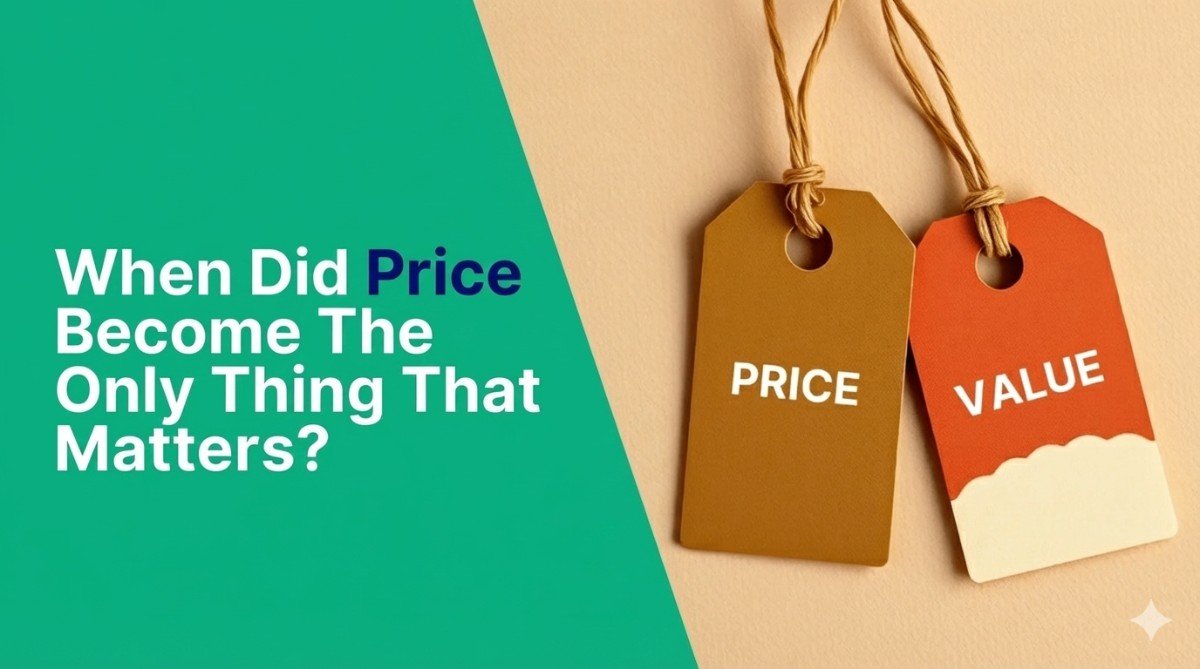
The Real Cost of Letting Price Lead
Many businesses don’t set out to compete on price, but somewhere along the sales cycle, it quietly becomes the filter through which everything is evaluated. Not because value stopped mattering, but because it wasn’t made visible enough.
Across the industrial, manufacturing and broader B2B landscape, technical offers often look similar on paper. When differentiation isn’t clear, decisions naturally default to cost. Over time, this shifts attention away from capability, service, and long-term impact, and starts to erode margin, relevance, and trust.
When Price Becomes the Strategy
In many businesses, commercial decisions are shaped around a single pressure point: price.
“We need to stay competitive.” “Let’s match the lowest bid.” “Can we remove a few items to hit their budget?”
That mindset might win the job, but it comes at a cost:
- Eroded profitability
- Over-servicing to maintain relationships
- Team burnout
- Client expectations that don’t match the quote
- Difficulty attracting top talent
- And a growing dependence on discounts
When price becomes the centre of your strategy, you stop selling your strengths.
It’s Not Just the Buyer — It’s the System
It’s tempting to blame procurement processes or tight client budgets. But many businesses unknowingly train their customers to focus on price.
If proposals are vague, if positioning is technical but undifferentiated, or if the offer looks like every other vendor’s, then cost becomes the simplest comparison point.
Especially in sectors where services are complex but poorly explained, price becomes the only thing that feels tangible.
So, What Justifies Your Price?
You can’t just charge more because you want to. You have to demonstrate why it’s worth it — and why your offer goes beyond the transactional.
Premium pricing isn’t earned by being competent. It’s earned by being different in a way that creates measurable value for the client.
That might mean:
- Introducing innovation that helps clients stay ahead of industry change
- Solving high-cost, high-stakes problems with smarter thinking, not just faster delivery
- Improving performance or uptime through better-engineered systems
- Reducing risk or complexity in ways others can’t
- Bringing new insights, new methods, or new materials to stagnant categories
- Delivering long-term gains, not just short-term outcomes
These are not soft points. They are strategic levers. But they only work if you articulate them well. If your offer sounds like everyone else’s, the buyer defaults to price. If your offer clearly changes the game, the conversation changes too.
Marketing Isn’t Fluff. It’s Clarity.
This is where many industrial and B2B businesses hold back.
They believe the work should speak for itself. They see marketing as surface-level. They rely on word of mouth and repeat business.
And they assume the buyer already knows the value. But if your client can’t articulate what sets you apart, they will fall back on price.
Strategic marketing isn’t about gloss. It’s about clarity. It defines what you stand for, how you solve real problems, and why it matters commercially.
Word of Mouth Isn’t a Growth Strategy
Referrals and relationships are essential, but they are not a scalable growth strategy.
You need to be remembered before you’re needed. And you need to shape perception before the RFQ is sent out. If your value is only visible to people who already know you, you’re invisible to those who don’t.
Why Don’t More Businesses Invest in This?
Because many still don’t understand the difference between sales and strategic marketing.
They view marketing as a surface-level activity — a logo, a brochure, and a few social media posts. Something nice to have, but not essential to the business’s growth.
They treat it as an expense, rather than a strategic investment in market position, reputation, and long-term opportunities.
You don’t need to become flashy. However, you must be clear about what you stand for, why it matters, and how it drives commercial value.
Final Thought
Price will always be a factor. But it should never be the only thing that defines your business.
If you don’t shape how the market sees your value, someone else will. And they’ll start by asking, “What’s your price?”
The better question is: What’s your value — and is it clear enough for clients to pay for?
At Neo Jupiter, we help industrial, technical and B2B brands reposition with clarity, communicate what makes them different, and grow with purpose.
📩 Let’s talk. Book a call or connect directly to explore how we can help position your business for growth.

Mira Varathan
Co-Founder & Director of Strategic and Digital Marketing, Neo Jupiter Marketing